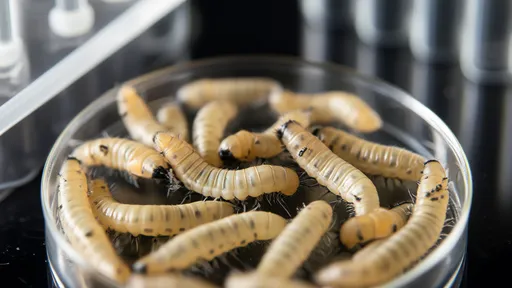
The global food system is undergoing a quiet revolution, one that crawls on six legs and thrives in decaying organic matter. Black soldier fly larvae (BSFL), the unassuming offspring of the Hermetia illucens fly, are emerging as nature’s most efficient protein factories, capable of transforming food waste into high-quality animal feed and fertilizer. This biological alchemy isn’t just a scientific curiosity—it’s becoming a cornerstone of the circular economy, offering solutions to some of humanity’s most pressing environmental challenges.
In windowless warehouses across Europe and Southeast Asia, vertical farming operations hum with activity as millions of wriggling larvae feast on supermarket rejects, brewery spent grains, and agricultural byproducts. Unlike traditional livestock, these insects require no arable land, emit negligible greenhouse gases, and convert feed to protein at rates that make chicken farms look wasteful. The math is staggering: where cattle need 8 kg of feed to produce 1 kg of weight gain, BSFL achieve the same on just 1.3 kg of organic waste.
The nutritional profile of dried BSFL reads like a superfood manifest—42% crude protein containing all essential amino acids, 35% lipids rich in lauric acid (a potent antimicrobial), and chitin fiber that functions as a prebiotic. Aquaculture operations were early adopters, replacing unsustainable fishmeal in salmon and shrimp feeds, but the applications have since exploded. Pet food manufacturers now market BSFL-based treats for dogs with poultry allergies, while startups are microencapsulating larval oil as a sustainable palm oil alternative in baked goods.
What makes this system truly revolutionary is its self-regulating biology. Adult black soldier flies don’t eat—they live only to mate and lay eggs before dying—eliminating disease vectors common in other insect farms. The larvae’s gut microbiome produces antimicrobial peptides that neutralize pathogens like E. coli and Salmonella in their feedstock. This means they can safely process contaminated waste streams, including pre-consumer food waste containing meat and dairy, which are typically excluded from composting.
The byproducts of this process are as valuable as the protein harvest. Larval frass (excrement) has been shown to increase crop yields by 20% compared to chemical fertilizers while suppressing fungal diseases. Some operations are even harvesting the molted exoskeletons to produce chitosan for water purification and biodegradable plastics. Dutch researchers recently demonstrated that BSFL enzymes can break down polyethylene films, hinting at potential applications in plastic waste remediation.
Scaling this technology presents fascinating engineering challenges. Automated separation systems using vibrational frequencies and airflow patterns can now harvest 10 tons of larvae per hour with 99% efficiency. Climate-controlled rearing facilities leverage machine learning to optimize temperature gradients and feeding schedules, reducing maturation time from 14 days to just 9. The most advanced operations are integrating black soldier fly production with biogas plants, where leftover organic matter undergoes anaerobic digestion to power the insect farms.
Regulatory landscapes are struggling to keep pace with the innovation. While the EU approved BSFL for poultry and pig feed in 2021, US regulations remain fragmented across states. The bigger battle is consumer perception—marketers carefully avoid close-up footage of wriggling masses, instead emphasizing the powder’s resemblance to matcha tea. Culinary pioneers are sidestepping the "ick factor" entirely by using BSFL protein as fermentation feedstock for mycoprotein meats and dairy alternatives.
The economic implications are profound. A single mid-sized BSFL facility can process 100 metric tons of food waste daily—equivalent to a city of 300,000 people—while producing 15 tons of protein and 30 tons of fertilizer. In Nairobi’s slums, urban farming cooperatives are using small-scale BSFL units to create closed-loop systems where market waste feeds larvae that nourish chickens whose eggs feed families. This decentralized model could revolutionize food security in developing regions lacking refrigeration infrastructure.
As climate change intensifies pressure on conventional agriculture, the black soldier fly’s unique biology offers a rare convergence of environmental and economic benefits. From reducing landfill methane emissions to displacing soy cultivation (a major driver of Amazon deforestation), this unassuming insect is proving that the most sustainable solutions often come from working with nature’s existing blueprints rather than against them. The protein revolution won’t be televised—it’ll be crawling quietly through our food waste, one larva at a time.

By /Aug 1, 2025

By /Aug 1, 2025

By /Aug 1, 2025

By /Aug 1, 2025
By /Aug 1, 2025
By /Aug 1, 2025

By /Aug 1, 2025
By /Aug 1, 2025
By /Aug 1, 2025

By /Aug 1, 2025
By /Aug 1, 2025
By /Aug 1, 2025
By /Aug 1, 2025
By /Aug 1, 2025

By /Aug 1, 2025

By /Aug 1, 2025

By /Aug 1, 2025

By /Aug 1, 2025

By /Aug 1, 2025
By /Aug 1, 2025
