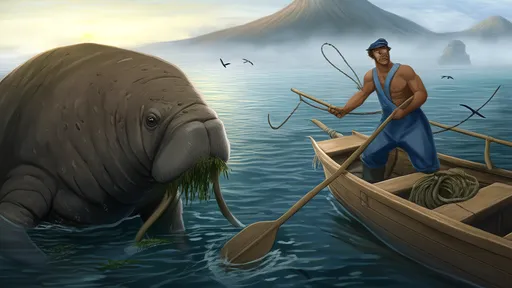
The waters of the Bering Sea once teemed with a gentle giant—the Steller’s sea cow. A massive marine mammal that could reach lengths of up to 30 feet, it was a docile creature, grazing on kelp in the shallow coastal waters. Yet, within a mere 27 years of its discovery by Europeans, the species was hunted to extinction. The story of the Steller’s sea cow is not just a tragic footnote in natural history but a stark reminder of humanity’s capacity to drive entire species to oblivion with breathtaking speed.
In 1741, the German naturalist Georg Wilhelm Steller first documented the sea cow during Vitus Bering’s ill-fated Arctic expedition. Stranded on what is now known as Bering Island, Steller observed these colossal animals with fascination. He noted their social behavior, their apparent fearlessness, and their reliance on dense kelp forests. Little did he know that his detailed accounts would soon become the only scientific record of a species on the brink of annihilation.
The sea cow’s fate was sealed almost immediately after its discovery. Sailors and fur hunters, drawn to the region by the lucrative sea otter trade, quickly realized that the slow-moving, defenseless sea cows were an easy source of meat and fat. Unlike other marine mammals, they did not flee from humans. Their blubber provided oil for lamps, their skin was used for boats, and their meat could sustain crews for months. The slaughter began in earnest, and the sea cows, which had no natural predators before human arrival, were utterly unprepared for the onslaught.
What made the extinction even more staggering was its speed. By 1768, just 27 years after Steller’s first encounter, the last known sea cow was killed. The entire population, estimated to have been around 2,000 at the time of discovery, was wiped out. The very traits that made them unique—their size, their docility, their reliance on coastal habitats—made them vulnerable. They were hunted faster than they could reproduce, and their restricted range left them with nowhere to hide.
The tragedy of the Steller’s sea cow is not just a story of greed and shortsightedness. It also highlights the fragility of ecosystems. The sea cows played a crucial role in their environment, maintaining kelp forests by grazing on fast-growing species. With their disappearance, the underwater landscape of the Bering Sea changed irrevocably. The cascading effects of their extinction likely altered the marine ecosystem in ways that are still not fully understood.
Today, the Steller’s sea cow exists only in skeletal remains, scattered museum specimens, and Steller’s meticulous notes. Its extinction stands as one of the earliest and most dramatic examples of human-driven species loss. Yet, it was far from the last. The sea cow’s story serves as a cautionary tale—one that grows more urgent with each passing year as countless other species face similar threats from overhunting, habitat destruction, and climate change.
In an age where conservation efforts strive to protect endangered species, the sea cow’s demise reminds us of what happens when exploitation goes unchecked. It is a lesson written in blood and blubber, a mournful echo from the depths of the Bering Sea. And as we grapple with the ongoing biodiversity crisis, the sea cow’s 27-year extinction remains a sobering testament to the irreversible consequences of human actions.

By /Aug 1, 2025
By /Aug 1, 2025

By /Aug 1, 2025
By /Aug 1, 2025
By /Aug 1, 2025
By /Aug 1, 2025
By /Aug 1, 2025
By /Aug 1, 2025
By /Aug 1, 2025
By /Aug 1, 2025

By /Aug 1, 2025

By /Aug 1, 2025
By /Aug 1, 2025

By /Aug 1, 2025
By /Aug 1, 2025

By /Aug 1, 2025

By /Aug 1, 2025

By /Aug 1, 2025

By /Aug 1, 2025

By /Aug 1, 2025
