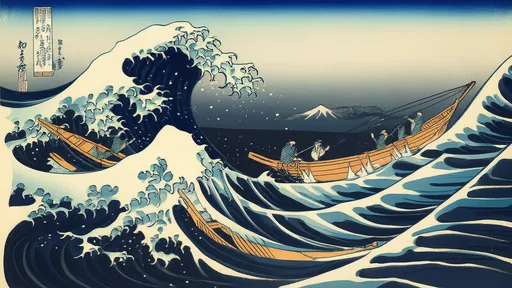
The towering crest of Katsushika Hokusai's The Great Wave off Kanagawa has long been more than just a masterpiece of ukiyo-e—it is a frozen moment of tension between humanity and the untamed sea. Beneath the surface of this iconic woodblock print lies a narrative of struggle, survival, and the delicate balance between fishermen and the marine ecosystem they depend on. The wave, poised to crash upon two fragile oshokubune (fishing boats), becomes a metaphor for the relentless challenges faced by those who harvest the ocean's bounty.
Hokusai's composition is deceptively simple yet rich with symbolism. The boats, dwarfed by the wave's fury, are manned by crews hunched low, their postures a mix of resignation and determination. These fishermen were part of Edo-period Japan's thriving coastal economy, where daily survival hinged on outmaneuvering not just the elements but also the unseen creatures beneath the waves. The print omits explicit depictions of marine life, yet their presence is implied—the tuna, sea bream, and squid that fueled livelihoods, and the predators that followed in their wake. The ocean here is both provider and adversary.
Modern marine biologists have noted the accuracy of Hokusai's wave dynamics—the foam-fringed "claws" suggest a subsurface turbulence indicative of nutrient-rich currents. Such waters attracted fish schools, making them prime fishing grounds despite the danger. Historical records from the 1830s describe fishermen venturing beyond Tokyo Bay into deeper, rougher waters where yellowtail amberjack and mackerel thrived. Their wooden boats, though agile, were ill-matched against sudden storms. The Great Wave, then, immortalizes a calculated risk: braving nature's wrath for a chance at abundance.
Beyond its literal interpretation, the wave embodies the ecological paradox of fishing cultures. Edo-period Japan saw early examples of sustainable practices, such as rotational fishing zones and seasonal bans, yet overfishing near coastal villages already hinted at dwindling catches. The boats in Hokusai's print might symbolize humanity's perpetual dance with scarcity—the harder fishermen fought to extract from the sea, the more precarious their position became. Even Mount Fuji, serenely distant in the background, seems to observe this cycle with detached wisdom.
The absence of visible fish in The Great Wave speaks volumes. Unlike Western seascapes that often romanticize plenty, Hokusai focuses on the act of pursuit rather than the prize. This mirrors the Japanese concept of mono no aware—the bittersweet awareness of life's transience. For fishermen, each voyage carried the possibility of empty nets or capsized boats, yet they rowed onward. Today, as industrial fishing strains global fish stocks, Hokusai's 19th-century imagery feels eerily prescient: a reminder that the ocean's generosity has limits.
Contemporary artists and environmentalists have reinterpreted The Great Wave to reflect modern crises. Some versions replace the boats with plastic debris or render the wave from microplastics, drawing parallels between historical struggles and today's ocean pollution. Others insert silhouettes of overfished species like bluefin tuna, now a fraction of their Edo-era numbers. These adaptations underscore how Hokusai's work transcends time—the博弈 he depicted continues, albeit with higher stakes and fewer resources.
What would Hokusai's fishermen make of today's industrialized fleets? Their hand-thrown nets and wooden hulls have given way to sonar-equipped trawlers that scrape seabeds bare. Yet the essential dynamic remains: humans still bend to the ocean's rhythms, even as technology creates illusions of control. Climate change adds another layer—rising sea levels and acidification threaten to reshape coastlines and fisheries much as the Great Wave reshapes itself moment by moment in the print.
Perhaps the enduring power of The Great Wave lies in its refusal to resolve the tension it depicts. The wave neither crashes nor recedes; the boats neither sink nor escape. Similarly, our relationship with the ocean exists in perpetual imbalance—a push-and-pull between need and exploitation, reverence and conquest. As we face an era of ecological reckoning, Hokusai's frozen surge invites us to reconsider who, in this ancient博弈, is truly formidable: the fishermen, the fish, or the sea itself.

By /Aug 1, 2025
By /Aug 1, 2025
By /Aug 1, 2025
By /Aug 1, 2025
By /Aug 1, 2025
By /Aug 1, 2025
By /Aug 1, 2025
By /Aug 1, 2025
By /Aug 1, 2025
By /Aug 1, 2025
By /Aug 1, 2025

By /Aug 1, 2025
By /Aug 1, 2025

By /Aug 1, 2025
By /Aug 1, 2025
By /Aug 1, 2025
By /Aug 1, 2025

By /Aug 1, 2025
By /Aug 1, 2025

By /Aug 1, 2025
