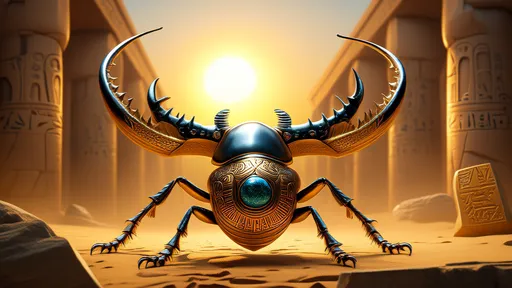
The ancient Egyptians held a profound reverence for the scarab beetle, an insect that might seem insignificant at first glance. Known scientifically as Scarabaeus sacer, this humble creature became a powerful symbol of creation, transformation, and the eternal cycle of life. At the heart of this symbolism lay the beetle’s peculiar habit of rolling dung into perfect spheres, an act that the Egyptians saw as a mirror of the sun’s journey across the sky. The scarab, therefore, was not just an insect but a living emblem of the divine.
To understand the scarab’s significance, one must delve into the Egyptian worldview, where the natural and the supernatural were deeply intertwined. The daily rising and setting of the sun were not mere astronomical events but sacred rituals performed by the sun god Ra. As Ra traveled through the sky in his solar barque, he brought light, warmth, and life to the world. The Egyptians observed the scarab pushing its dung ball with the same relentless determination, and in this motion, they saw a microcosm of Ra’s celestial voyage. The beetle’s laborious task became a sacred metaphor—the dung ball represented the sun, and the scarab, like Ra, was a tireless creator and sustainer of life.
The connection between the scarab and the sun was further solidified by the beetle’s life cycle. Female scarabs lay their eggs within the dung balls, which serve as both nourishment and protection for the developing larvae. When the young beetles emerge, it appears as though they have arisen spontaneously from the earth. This phenomenon resonated deeply with the Egyptian belief in resurrection and rebirth. Just as the sun "died" each evening only to be reborn at dawn, the scarab embodied the promise of renewal. This parallel made the scarab a potent symbol of immortality, often placed in tombs to ensure the deceased’s safe passage into the afterlife.
The scarab’s religious importance manifested in countless artifacts, from amulets to monumental carvings. Scarab-shaped seals were used to stamp official documents, and heart scarabs—inscribed with spells from the Book of the Dead—were placed over the hearts of mummies to protect them in the afterlife. The most famous of these is the Great Scarab of Amenhotep III, a colossal stone sculpture that still stands in Luxor. These artifacts were not mere decorations; they were conduits of divine power, imbued with the scarab’s sacred energy.
Beyond its solar associations, the scarab also symbolized the concept of kheper, an Egyptian word meaning "to come into being" or "to transform." The god Khepri, often depicted as a man with a scarab for a head, was the embodiment of this idea. Khepri was the dawn form of Ra, the force that pushed the sun above the horizon each morning. In this role, he represented the eternal cycle of creation and destruction, a theme central to Egyptian cosmology. The scarab, therefore, was not just a symbol of the sun but of the very process of existence—a reminder that life is perpetually renewed through struggle and perseverance.
Even today, the scarab remains one of the most recognizable icons of ancient Egypt. Its image adorns jewelry, souvenirs, and modern artworks, a testament to its enduring appeal. Yet, for the Egyptians, the scarab was far more than a decorative motif. It was a sacred bridge between the earthly and the divine, a creature whose humble labor mirrored the grandest cosmic rhythms. In rolling its dung ball across the sand, the scarab enacted a daily miracle, reminding all who witnessed it of the sun’s eternal journey and the promise of rebirth that lies at the heart of existence.
By /Aug 1, 2025

By /Aug 1, 2025
By /Aug 1, 2025
By /Aug 1, 2025
By /Aug 1, 2025
By /Aug 1, 2025
By /Aug 1, 2025
By /Aug 1, 2025
By /Aug 1, 2025

By /Aug 1, 2025

By /Aug 1, 2025
By /Aug 1, 2025

By /Aug 1, 2025

By /Aug 1, 2025
By /Aug 1, 2025
By /Aug 1, 2025
By /Aug 1, 2025
By /Aug 1, 2025
By /Aug 1, 2025
By /Aug 1, 2025
